Showing posts with label Analysis. Show all posts

B&W lighting - The Lady From Shanghai

I either hate or love a black & white film. I love a b&w film if the photography tries to emphasise the art of silhouette and understands the complexity of simplification. I hate watching a b&w film if it's a bunch of uninteresting grey objects not knowing their places in any order of focal points, as if it's yearning to be in colour but the technology was too expensive at the time (or didn't exist yet).

The best example of b&w photography I seen so far is in The Lady From Shanghai by Orson Welles. There is a famous back-story behind this movie, and perhaps lead to the result of its failure to make a profit.

At the time Orson Welles was married to Rita Hayworth, the most famous pin-up model in her day well known for her luscious long red hair. The marriage was rather shaky, by then they had a daughter but even that couldn't keep the two together. Rita suffered from abuse as a child and Orson didn't know how to deal with that. Orson was doing a stage production of "Around The World in 80 Days" but was in debt to the costume company and needed the money to get the costumes the day before the play opened, so he called the head of Columbia pictures and borrowed the money to pay off the debt, in return he would make a picture adapted from the closest book within his reach, which happened to be some pulp-fiction noir his secretary was reading. When it came time to make the film his wife, Rita, wanted to co-star in the picture in an attempt to bring the two closer together. Orson reluctantly agreed, but he knew her trademark red hair would not work in the kind of film he was making. After all, what is red hair in b&w photography? Just some useless grey. So he made her cut her hair short and become an extreme blonde. Perhaps he knew there would be a public backlash to changing Rita Hayworth's famous pin-up look, however Orson only had one thing on his mind - to make a good movie - and so he did.

Some time after the movie was wrapped up, Rita and Orson decided it wasn't working out and got a divorce. The film was released two years later and in the public mistakenly viewed it as the cause for the break-up, and so fell out of the public favour and flopped.

Story-wise, The Lady From Shanghai plays out like a typical noir page-turner. Each scene keeps revealing new and intricate turns. To describe its plot properly would take about the amount of time to watch the film itself. But say what you want about the story, the film's look is a marvel on to its own. As an example I will take a single-shot from one of my favourite scenes - besides the house of mirrors climax - in the aquarium. The complexity of the lighting is a feast for the eyes, and I still can't tell whether it's in a real aquarium with strange refraction tricks or if it's a processing-screen behind them. The fish are distractingly huge, like Werner Herzog would say, they seem to be a metaphor for something but I don't quite know what.

Here are some screen-shots from one of the final moments in the aquarium, all taken from a single shot of Orson and Rita walking past the camera.

The beginning of the scene. Rita's full figure as she is walking and her face is half-cast in shadow. Orson is about to walk into frame.

Now we have both Orson and Rita in frame, walking towards us. The camera is currently stationary. Notice the shades of their clothing. Rita's coat is a pure black over a lightly shaded dress, you can't see the shape of her arms or chest, but you see her hands coming out, clinging on to a black purse. Orson is in a totally dark suit(in some shots it's all pure black), with a slightly less darker shirt underneath, along with his black hair, he's just a walking shadow save for his face and hands. It is to due to his dark attire that we can keep an eye on the white piece of paper he is holding, as it plays an important role to the story (I won't go into it here, I recommend watching the film).
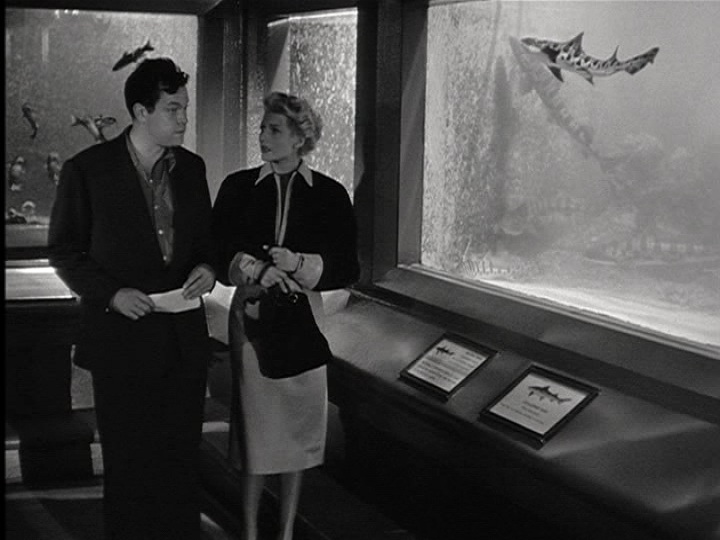
They walk closer, the light has shifted a little darker in this shot. In movement, the light is constantly shifting up and down due to the water bouncing light in all sorts of directions. This is why it was important to separate the extremes of dark and light, because all the medium greys in between were going to be constantly shifting.

They come closer into a medium shot. Here, the camera begins to slowly turn right, constantly keeping the two slightly left-of-centre.

Even closer, and as the camera turns Orson's head casts a shadow over Rita's face.

I particularly love this frame. As Rita's face is being eclipsed, her eyes still glow out of the darkness. Their silhouettes become extremely defined in front of the bright fish-tanks.

However, notice when they're in front of a pure-black column. Rita's face and hair has become much brighter, but her body has completely disappeared. Orson is now walking in front of the camera as we come to the apex of its turn.

Both characters have switched sides, however remain left-of-centre. Rita still has glowing eyes and now she has gained glowing teeth!

Orson is the first to completely turn his back on us. Rita's face is becoming much darker, however when she's in front of a black column her blonde hair is lit up.


The camera has stopped turning and it is now tracking behind Rita and Orson. Pay attention to Orson's signature cheek, and how the light shifts as he walks past a black column. Keep in mind, this is all in the same shot.

For a while the camera tracks both characters as they talk with their backs turned towards us. How often do you see that in movies? I'm not saying it doesn't happen, but if it does, then it's usually for a reason. In this shot, it's totally casual, and it helps that it's just two characters - a man and a woman - so we can distinguish the voices.

The shot ends with both characters turning in profile looking at each other and the camera has stopped moving. Both faces are engulfed in shadow, with a bit of light outlining them both to separate them from the dark-grey background.


It's after that final turn, Rita talks for a bit, then there is a cut. To me this is the greatest example of black & white cinema. In the old days there was a lot of cigarettes being smoked on the screen, to create a constant movement even when the characters are static. To me it seems cheap and easy to just have someone smoking, especially if it adds nothing to the character. That's why I liked Orson Welles' films as he would always be inventive with movement. So go watch The Lady From Shanghai and see how film is really made!

HOW OFTEN DOES FUNNY GAMES BREAK THE FOURTH WALL?


More often than you think. The story imposes itself as a challenge for the viewer to deconstruct, constantly alienating while manipulating them simultaneously. The film is drawn into its own self-awareness, as if giving criticism of the story within the story itself.

DISCLAIMER:
Of the two characters interchangebly called "Peter and Paul", "Tom and Jerry" or "Beavis and Butt-Head" (I can't remember who's called what), I will refer to them as "the tall one" and "the fat one" based on Haneke's own explanation that they are modelled off a stereotypical clown duo.

FIRST EXAMPLE - THE MUSIC

The opening titles at the very beginning contains a visceral moment of immediate alienation. The family are enjoying a road game of "Guess the Opera" when all of a sudden Haneke deploys non-diegetic music with no warning whatsoever. It is a very loud, brutal and dissonant type of art/noise-thrash (by New York art/jazz musician John Zorn) purely designed to shock and put you into discomfort. Even for a lover of abrasive noise music like myself, it's the juxtaposition of the sound against the smiling, loving faces of the family that conveys the sense of bother.

The brilliance of this moment is only realised much later in the film; the scene when the boy escapes to their neighbour's house to hide. The tall one chases after him and plays a sort of "Hide and Seek" game in the house. Here he puts on a CD and once again it is John Zorn, only this time it's diegetic. The first logical question to ask is "where did this CD come from?" Certainly a burgeois household of this sort wouldn't have anything of such taste in their collection? It's not impossible, but it is extremely out of character. The answer might be that the tall one (who has by now physically looked past the fourth wall and spoken words to the viewer) must have brought the CD with him. One could even say that Haneke passed it over from behind the camera while we were looking somewhere else. Thinking back to the opening title sequence, and even the ending credits, perhaps the tall one has some control over the film's output from behind the fourth wall the whole time?

SECOND EXAMPLE - NARRATIVE DEVICES

FUNNY GAMES is so full of blatant narrative conventions it almost feels like Haneke's great big inside joke. I won't be able to discuss all of them here, but there are a few subtle examples that stick out in my mind more than any others.

Firstly there is the boat's knife.

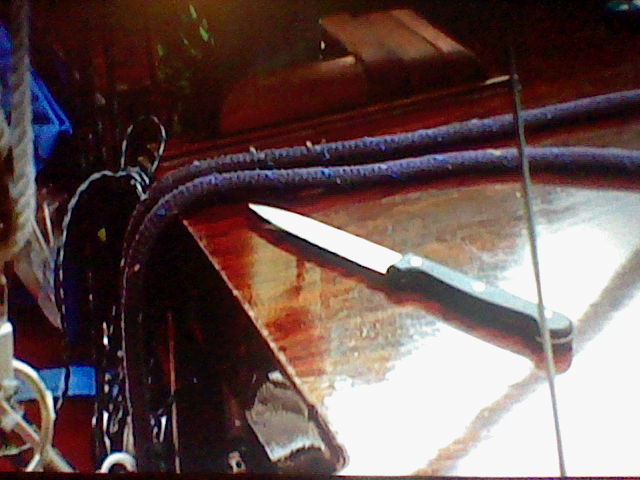
Although it has already been established that the boy has borrowed a knife and taken it to the boat, Haneke wanted us to make sure we notice that knife by giving it its own insert-shot. In fictional analysis this is referred to as "Chekhov's Gun" (Chekhov says that if you introduce a rifle in the first chapter it must absolutely go off in the second or third chapter, otherwise don't introduce it at all). If it's not obvious enough that we see the knife, when the rope pulls it in the boat we get an exaggerated whooshing sound which indicates about the same amount of power as Xena: Warrior Princess waving around her broad-sword. The knife turns out to be a Red Herring (when "Chekhov's Gun" turns out to be completely useless) but we do see the real gun at another point in the movie.

So anyway, why does the dog bark so much at these two guys?

We saw it just earlier when it was much more playful and obedient. It doesn't seem like the vicious protective type, but then it goes berserk as soon as--oh.. oh right, they're the bad guys.

Then there's the golf ball.

The same could be said about the eggs, but what does the golf ball represent? It seems to come off as being significant as it makes pivitol appearances in the story. Is it a symbol of anxiety? The every-day noose around the neck one is trying to escape from in this sport, or rather luxury, designed for the upper-middle class? But really, I think it's just a McGuffin. It pretends to signify something important but its only use is to say "here I am! Time to move the plot forward." It's a kind of device that stares at you directly, and silently, so in reality it's not directly criticising you, it makes you resort to criticising yourself.

The golf ball is one of many psychological effects this movie has on the viewer. My favourite scene is also the most difficult scene for me to sit through. It is when the fat one is innocently asking for some eggs on behalf of the neighbour. Although the characters are polite and well adjusted, there is an incredible tension building increasingly as the scene goes on, and it's always there no matter how many times I watch it. You know the plot of the film - two intruders enter a family's vacation house and terrorise them until they are all slaughtered by the morning - so the eggs scene is the obvious build-up before the terror; we only came to see this movie for the terror. But the scene, it is drawn out for an excruciatingly long time, in my head I'm screaming "TAKE ME TO THE VIOLENCE ALREADY!!!" It is here when Haneke shows you who you really are. He says so himself in an interview:

Basically, you have the option to sit there and take it, or just walk away.

Just walk away...

THIRD EXAMPLE - THE ACTORS

(more to come)

Das Schloss, ein film von Michael Haneke (a quick analysis)


This is quasi-Alice related, but I'll get to that later. I would really like to talk about this film, and how I find it a)thoroughly more enjoyable than the book and b)irresistable to rewatch over and over again. I have not done too much research on this movie, there is very little information about its production. All that I know is that it was made for television. I have a theory that Haneke simply made it for the money to make ends meet on his production of "Funny Games", which was also completed in the same year (1997) and with some of the same actors. But I could be (and should be) wrong. It seems like a much "lesser" Haneke film, but it's become one of my favourites for many reasons as I will discuss. So from an un-researched viewpoint, I will not be able to draw on too many facts other than comparisons to the book and comparisons to other Haneke films. This will be a pure analysis based on what is presented on the screen.

The book was written by Franz Kafka (translation: "The Castle") back in 1926. I was interested in reading this book because Kafka's name was dropped in another book I was reading called "Alice in Wonderland and Philosophy" - a nice book about philosophy but a terrible book about interpritations of the Alice stories - there was one chapter about the art of nonsense in literature. The chapter, written by Charles Taliaferro and Elizabeth Olson argues that nonsense is a wonderful literary device if there is a grounded protagonist who gives the perspective of sanity, and through their eyes the nonsense remains alien and/or humourous. Then they argue the dangers of absurdity, such as Kafka, Nikolai Gogol or Eugene Ionesco, where "these works tread deeper and deeper into senseless strife and violence... life and death itself become almost meaningless." I thought this was pretty cool, so I went out and bought a copy of "The Castle", translated by J. A. Underwood (who I later discovered is more of a "Kafka-purist", in terms of style that means he translated the original untainted manuscripts and left the lengthy paragraphs unbroken) and started reading right away. One thing to note on Kafka's book, in fact on his three only novel attempts, is that they were never completed before he died. "The Castle" even breaks off at mid-sentence, which plays to great emphasis in Haneke's adaptation.

There are two ways I can relay the story, the normal way in which I simply explain the entire event and give exposition in an orderly structured fashion, or relay the events and exposition as they are chronicled in the story, so as not to spoil the experience of the way it presents itself. Alternatively, I could not relay the story at all, which is what I'm going to do. For those who know the story, it would just be a tedious exercise in revising what you know already. For those who don't know the story, I would hate to spoil the joy of having it unravel in the way it should be experienced. This goes for either reading the book or watching the film by Haneke (I have not seen any other adaptations). Haneke has managed to follow the events of the book exactly as they are ordered, easily deceiving the audience in thinking it is a faithful adaptation. I don't think it is all that faithful, not in the sense of its compression of the events and dialogues, but in its stylistic display it is more of a Haneke experience than Kafkaesque.

In adapting the book to film I have noticed Haneke making considerable changes, each with a variety of reasons which I can only assume, however I will discuss each type of change with an example. They are:

Compression
There are events and, most notably, dialogue which are hugely compressed. This is the key reason for my enjoyment of the film over the book. Kafka was able to explore the extremes of novel-writing when he was able to give each character their own 10-page monologue about this and that, except not to say it's this, but as it is that then this will lead to that, not because of this but because of that. It's bad enough to stop the story dead within a book, since reading is a whole different psychology to watching, but to do that in a film will virtually stop the world turning - birds will fall out of the sky and anyone with a pacemaker will die instantly. One moment of extremely clever compression I noticed was the dialogue between K. and the landlady of the village inn, the next morning after Frieda had decided to leave her position at the Herrenhof. K. decides that he wants to talk to Klamm, but the landlady argues it is impossible. Haneke's reduction of this dialogue is beautiful, for the film there was no need for backstories, over-exposition or "this and that", K. just wanted to get out and find answers. It is a joy for me to watch this scene (all framed in a single shot) inversely proportional to how much it was a pain to read it in the book.

There are two other big compressions, one I would deem an omission, so that makes one other compression, which I couldn't help noticing. The conversation between Olga and K. at Barnabas' house, which takes up several chapters in the book, was reduced to a very small conversation. This was a part of the book I did enjoy reading, there were a lot of revelations discussed about the beaurocratic nature of village and its castle, and a whole history of the downfall of the Barnabas family. While it was all fascinating, the compression here was also necessary to Haneke. The beaurocratic nature is already discussed two other times (which I will including in the "keeping" section), and there is also Haneke's sense to leave explanations open - and this is what greatly intrigued me about the film - which has this strange incompatibility with Kafka's writing yet still makes for a compelling story.

Omission
There was one particularly large omission I couldn't help but notice. Well, make that two, except the other would be better off under "changing". And then there are another two I can think of, one of which I mentioned before under the "compression" section. Firstly, I will discuss the scene when K. talks with Erlanger at the Herrenhof Inn, then Erlanger leaves. In the book there is a giant display of chaos involving messengers and the gentlemen from the castle. Doors are flying open and slamming shut, messengers are taking letters and giving letters, then fighting or playing mind games with gentlemen in order to get messages from them or deliver messages to them. Then one gentleman in particular starts yelling and making a whole lot of noise and rings his bell, to which all the other gentlemen respond by joining in, then the landlord and the landlady walk in and grab K. by his arms and drag him out of the scene. K. only then learns that he was the reason there was so much noise and trouble, that he should have left immediately after Erlanger gave him his message. K. then has some absurd discussion with the landlady about the clothes she wears. All of this is completely gone in Haneke's adaptation. There was one important detail in this whole scene, as soon as the chaos dies down one of the messengers still has a single note left undelivered. K. wants to see what it is, but before he gets a chance the messenger rips up the note and puts it in his pocket. Such an action gives confirmation to the Mayor's long speech about how such gross miscommunication can come about and result in a mistake such as K.'s arrival to the village. There are two reasons why I can think this scene was ommited entirely. First is the budget would probably have no room for it, and considering Haneke's demand for absolute technical precision, such a thing would be out of the question. Second is that it has already been explained by the Mayor (see the "keeping" section), and thus is my argument for this film being more Hanekesque than Kafkaesque. It's almost like a mathematical elegance, to cut down the fat and give you the absolute essential information. The rest of the information around it is all there, but you don't need to be told explecitely what it is, like Kafka would tell you, but rather it's all the things you can assume on your own.

Changing


Keeping


(more to come)