Showing posts with label unfinished. Show all posts

HITCHCOCK-BLOCKED

(This post will remain pictureless)

1.

I have recently been going on an Alfred Hitchcock-spree, not so much "getting into" his movies but more like "catching up". I've already seen PSYCHO and I think enough has been said about that movie by others so I will not go into length about it right now. I recently caught up with ROPE, which I consider more of an experiment rather than a film, however I still enjoyed it and not much needs to be said other than appreciating it for its technical feats (and follies) --NOTE: between writing the first draft of this post and now I also saw THE BIRDS and it was fantastic, but will require its own posting after this-- The film I will be discussing here is VERTIGO, but first I must express my feelings towards Hitchcock in general.

2.

I am not a Hitchcock fan. The closest I can get to love the majority of his work is if I loved to hate them (THE BIRDS and ROPE excluded). The reasons why will be discussed using VERTIGO as the prime example, but the fact remains is that Hitchcock is a lasting influence for film-makers and story tellers to this day, if not then he is an influence of the influences. I can understand this, although I'm a fan of Orson Welles and he is considered influential to Hitchcock (compare TOUCH OF EVIL where Janet Leigh gets into trouble at an out-of-way motel with PSYCHO where Janet Leigh gets into trouble at an out-of-way motel). Hitchcock did things differently and told stories in new and exciting ways, in doing so creating everlasting conventions which have stuck with the modern film-makers of our time. Very often you find people making films refering to a scene as a "Hitchcock moment" or talking about "what Hitchcock would do", so where else is a better place to look for the leading moments of cinema than from the leader himself? This is when I decided to watch VERTIGO.

3.

VERTIGO contains everything I love and hate about Hitchcock. VERTIGO was apparently Hitchcock's "personal masterpiece", the one he self-indulged in the most out of all his films, the one he had to struggle with the most to get made. All the greats have them: Miyazaki has PRINCESS MONONOKE, Kubrick has EYES WIDE SHUT, Welles has CHIMES AT MIDNIGHT, Hanake has TIME OF THE WOLF, Kurasawa has RAN and Werner Herzog has just about every film he's ever made. These are the films that are the most difficult to sit through but the most revealing of its creator; and the most rewarding to the creator's ardent fans. You only really watch them in order to understand your heroes on a more personal level, like they are opening up their deepest secrets and fears just for you, but you have to prove your worth by actually making it to the end of the film first (not as easy as it sounds), then you can start appreciating the depth of what you just saw. Research is an important factor in understanding these types of movies, it's equally important to have seen the entire body of work from the director, or as much as you possibly can. Naturally, I dived right into VERTIGO without doing any of this, so my review will be biased towards the more "casual viewer" mentality.

4.

VERTIGO suffers from an ailment in film-maiking I call the "Hitchcock Stale". Many horror movies and, oddly enough, comic-book adaptations suffer from this. It's not to say Hitchcock invented it, but Hitchcock truly defines it and mastered it as his trademark. The "Hitchcock Stale" is made up of a combination of many symptoms, mainly to do with the director's total demand for complete control. Firstly, Hitchcock commisions a script to be written, commonly adapted from a book - sometimes the book is commissioned by Hitchcock - and adapted by a rotation of screenwriters. Once the script is approved by Hitchcock then he will never deviate from it. These scripts, by the way, are written more like shot-lists; basically the movie is already made before it is even filmed. It is frustrating for me when I can clearly notice a film-maker unable to "let go", the ones who suffer the most are the actors. The actors are not given any breathing room to give life to their characters. The spoken lines are flatly delivered, the movements are mechanical. I don't think it should be required of me to pay extra attention to a casual mundane conversation when it reveals required exposition. It's hard enough in an Orson Welles movie where he constantly provides visual distractions during an important complex conversation, Hitchcock on the other hand is boring me to sleep.

Another symptom of "Hitchcock Stale" is almost metaphorically egregious in VERTIGO. The protagonist's acrophobia - irrational fear of heights - seems to reflect Hitchcock's irrational fear of shooting on location. I wouldn't be surprised if all the outside scenes were shot by second-unit. A particular moment of conspicuous staleness is a scene with James Stewart and Kim Novac supposedly on a bay of rocks by the ocean, but obviously super-imposed over a pre-photographed movie behind them (including complimentary fake wind generated by off-screen fan). Hitchcock believes that close-ups must be shot with studio lighting, however I'm too distracted by the studio lighting on the actors mis-matching with the natural lighting of the outside location (a common problem that is noticeable on compositing special effects to this day). I'm guessing Hitchcock wanted to time a specific tidal-crash to a specific point of the conversation, but really, who cares?

5.

Despite its staleness, there are parts of VERTIGO I found extremely impressive, and I see in these parts where the Hitchcock inspiration comes from. Perhaps Hitchcock's inability to "let go" comes from the great ideas he has to tell a story. I think the parts that shine the most in VERTIGO are the parts where Hitchcock puts faith in his collaborators. After a particularly long and boring expositional conversation (where I mentioned I nearly fell asleep) there is an extremely long set of scenes - almost like a slowed down montage - that eliminates dialogue altogether. It is here when the music of Bernard Hermann does the talking and I was able to become emersed in the world of the film. I don't know whether it's true or not that Hitchcock snatched Hermann from seeing CITIZEN KANE, but he certainly saw the benefits of putting more trust in the composer than anyone else (Bernard Hermann was even given credit as "sound adviser" on THE BIRDS, which was a scoreless movie save for the synthesised bird sounds).

I liked the editing of VERTIGO. There is a particular moment when James Stewart is following a car that seems to drive endlessly down-hill, which we can see is an editing trick that cuts out any flat-road or up-hill driving, but also an editing effect which expertly inserts the protagonist's distorted perspective into the viewer. Another distorting effect on the viewer is when it gives an "ending" about half-way through the film, and then provides a coda which seems to keep going and going, then you realise after thirty minutes or so that maybe there is more to the story, and you have to kind of re-position yourself to get back into the movie again. Unless that's just me, I don't know.

6.


(more to come)

HOW OFTEN DOES FUNNY GAMES BREAK THE FOURTH WALL?


More often than you think. The story imposes itself as a challenge for the viewer to deconstruct, constantly alienating while manipulating them simultaneously. The film is drawn into its own self-awareness, as if giving criticism of the story within the story itself.

DISCLAIMER:
Of the two characters interchangebly called "Peter and Paul", "Tom and Jerry" or "Beavis and Butt-Head" (I can't remember who's called what), I will refer to them as "the tall one" and "the fat one" based on Haneke's own explanation that they are modelled off a stereotypical clown duo.

FIRST EXAMPLE - THE MUSIC

The opening titles at the very beginning contains a visceral moment of immediate alienation. The family are enjoying a road game of "Guess the Opera" when all of a sudden Haneke deploys non-diegetic music with no warning whatsoever. It is a very loud, brutal and dissonant type of art/noise-thrash (by New York art/jazz musician John Zorn) purely designed to shock and put you into discomfort. Even for a lover of abrasive noise music like myself, it's the juxtaposition of the sound against the smiling, loving faces of the family that conveys the sense of bother.

The brilliance of this moment is only realised much later in the film; the scene when the boy escapes to their neighbour's house to hide. The tall one chases after him and plays a sort of "Hide and Seek" game in the house. Here he puts on a CD and once again it is John Zorn, only this time it's diegetic. The first logical question to ask is "where did this CD come from?" Certainly a burgeois household of this sort wouldn't have anything of such taste in their collection? It's not impossible, but it is extremely out of character. The answer might be that the tall one (who has by now physically looked past the fourth wall and spoken words to the viewer) must have brought the CD with him. One could even say that Haneke passed it over from behind the camera while we were looking somewhere else. Thinking back to the opening title sequence, and even the ending credits, perhaps the tall one has some control over the film's output from behind the fourth wall the whole time?

SECOND EXAMPLE - NARRATIVE DEVICES

FUNNY GAMES is so full of blatant narrative conventions it almost feels like Haneke's great big inside joke. I won't be able to discuss all of them here, but there are a few subtle examples that stick out in my mind more than any others.

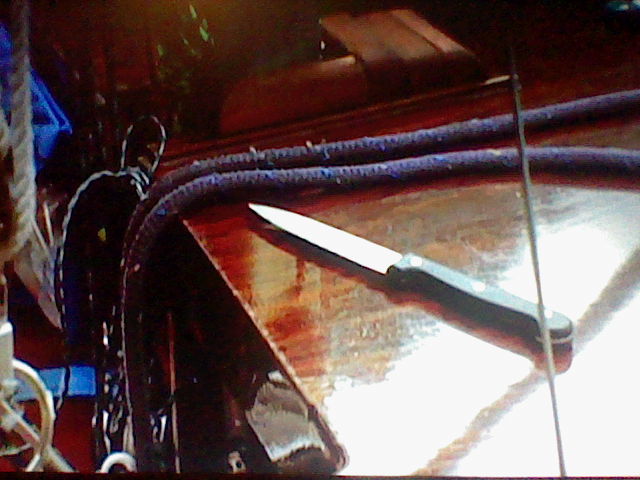
Firstly there is the boat's knife.

Although it has already been established that the boy has borrowed a knife and taken it to the boat, Haneke wanted us to make sure we notice that knife by giving it its own insert-shot. In fictional analysis this is referred to as "Chekhov's Gun" (Chekhov says that if you introduce a rifle in the first chapter it must absolutely go off in the second or third chapter, otherwise don't introduce it at all). If it's not obvious enough that we see the knife, when the rope pulls it in the boat we get an exaggerated whooshing sound which indicates about the same amount of power as Xena: Warrior Princess waving around her broad-sword. The knife turns out to be a Red Herring (when "Chekhov's Gun" turns out to be completely useless) but we do see the real gun at another point in the movie.

So anyway, why does the dog bark so much at these two guys?

We saw it just earlier when it was much more playful and obedient. It doesn't seem like the vicious protective type, but then it goes berserk as soon as--oh.. oh right, they're the bad guys.

Then there's the golf ball.

The same could be said about the eggs, but what does the golf ball represent? It seems to come off as being significant as it makes pivitol appearances in the story. Is it a symbol of anxiety? The every-day noose around the neck one is trying to escape from in this sport, or rather luxury, designed for the upper-middle class? But really, I think it's just a McGuffin. It pretends to signify something important but its only use is to say "here I am! Time to move the plot forward." It's a kind of device that stares at you directly, and silently, so in reality it's not directly criticising you, it makes you resort to criticising yourself.

The golf ball is one of many psychological effects this movie has on the viewer. My favourite scene is also the most difficult scene for me to sit through. It is when the fat one is innocently asking for some eggs on behalf of the neighbour. Although the characters are polite and well adjusted, there is an incredible tension building increasingly as the scene goes on, and it's always there no matter how many times I watch it. You know the plot of the film - two intruders enter a family's vacation house and terrorise them until they are all slaughtered by the morning - so the eggs scene is the obvious build-up before the terror; we only came to see this movie for the terror. But the scene, it is drawn out for an excruciatingly long time, in my head I'm screaming "TAKE ME TO THE VIOLENCE ALREADY!!!" It is here when Haneke shows you who you really are. He says so himself in an interview:

Basically, you have the option to sit there and take it, or just walk away.

Just walk away...

THIRD EXAMPLE - THE ACTORS

(more to come)

Witnessing the nth dimension

I'd like to experiment on exploring the difference between a description of something and the actual experience of it; in this case I will be talking about music and film. My choice in the mediums will be ones of particular complexity, so I can emphasise the mutual difference between feeling and understanding.

First I would like to relate this text from Alice's Adventures in Wonderland, when Alice is having a conversation with the Duchess:

___'I quite agree with you,' said the Duchess; 'and the moral of that is - "Be what you would seem to be" - or if you'd like it put more simply - "Never imagine yourself not to be otherwise than what it might appear to others that what you were or might have been was not otherwise than what you had been would have appeared to them to be otherwise."'
___'I think I should understand that better,' Alice said very politely, 'if I had it written down: but I ca'n't quite follow it as you say it.'

The trick of the passage is that it is written down, and in such a way you can read over it and follow its description and understand it. But imagine if it was said to you out loud. This is when it becomes an experience, and may put you at either a)a disadvantage due to being unable to follow its complex pyramid structure grammar or b)an advantage due to previously studying the phrase and dissecting its grammar so that it can be properly followed and understood as a sensible sentence.

The purpose of this exercise is to hopefully place one in situation (b), if one ever has the opportunity to come across any of the subjects of my experiment.

In Music

"Metal Machine Music" by Lou Reed

Description:
Taking an electric guitar and giving it an unusual tuning, Lou Reed would place it at various distances and positions close to its amplifier. The result is a feedback, which the frequency would hit the strings depending on the particular tuning, creating an overtonal vibration, The frequency of this overtone will collide with the overtones (or undertones) of other feedbacks when all mixed together, creating new overtones which collide with other new (and old) overtones - and on and on and on. All these feedback tracks were recorded on to tape, then manipulated and mixed together by Lou Reed's careful controlling hand. This constant infinite loop provides a sort of "therapy" for feedbackphiles, placed in 4 segements of 16 minutes (originally intended for it to played on vinyl), with the 4th segment infinitely looping in the ending groove around the centre of the disc.

Experience:
Unfortunately, I haven't experienced it on vinyl yet as it's a fairly difficult record to find. I do have it on CD, which provides an extreme outburst of high frequency noise, tediously carrying on like some kind of torture method. I still enjoy it immensely, and it only gets better with every listen.


The recent works of Meshuggah

Description:
In music, the rythm of a song is usually denoted by a time signature. The time signature looks like a fraction (eg. "3/4" or "4/4") whereby the denominator indicates the amount of equal parts the beat is divided into, and the numerator indicates how many of these beats will fill up the bar. Along come Meshuggah who decide to take the idea of screwing around with the weirdest and most unlikely time signatures in existence, then take it to further complications by having multiple time signatures playing at once, usually the hands of the drummer will be doing something manageable like 4/4 or 5/4 and the feet are off in their own world doing what's best described as "revolving time signatures". Mathematically, the combination would result as some twisted revolution of different time signatures I'm not even going to pretend to know or count. Sometimes the guitars are off on their own timings which complicates things further. Currently, Meshuggah reign as the kings of "Math Metal". Not only do they achieve inhuman possibilities in their composition, but they achieve machine-like precision in their sound.

Experience:
With the addition of a screaming vocalist, the lack of melodies give an overall thrash-sensibility, only the guitars seem to be strumming at any given random moment, fooling the listener in to headbanging when there is not a beat, and missing a potential headbang when the beat arrives. However, after many obsessive repeated listens, a headbanger will begin to understand the chaos and make sense of when to appropriately headbang. The consolation is in the fact that the guitar strumming and off-rythms are NOT random, the ultimate proof is in seeing this band perform live. An experienced listener will be able to headbang adjustingly - or just jump around and collide with other people in the mosh pit and crowd surf and stuff.


In Movies

"Adaptation" written by Charlie & Donald Kaufman and directed by Spike Jonze

Description:
During the production of "Being John Malkovich" Charlie Kaufman was given an assignment to adapt the book "The Orchid Thief" by Susan Orlean - a book mainly about flowers. It was Kaufman's decision to stay true to the book, to keep away from Hollywood conventions and just write a film that mainly concerns flowers. Meanwhile, 3 years ago, John Laroche (the "Orchid Thief") has been caught extracting various orchids from a state-protected swamp, only he was using the aid of native American indians to legally exploit a loophole to be able to extract them. During his court case, Susan Orlean enters the story to approach Laroche about making him the subject of her column in The New Yorker. By the way, I'm not just making an introduction to lead up to what this movie is about - this is all in the actual movie! The whole scene with Laroche and Orlean is the actual adaptation which Charlie Kaufman is writing. The movie proceeds to take us back and forth between Orlean's slow development of understanding Laroche, and never being able to, and Kaufman's slow development of his script, but never being able to write it. Enter Donald Kaufman, Charlie's twin brother, who has also decided to become a screenwriter. He attends a lecture by Robert McKee and suddenly decides he's going to write a thriller - one that he doesn't realise is the most conventional derived regurgitation of what has already been done a hundred times before. Over the course of the movie, we learn the past of John Laroche, yet haven't really gone anywhere with him yet, Charlie Kaufman enters himself and his brother into the script, plus his warts-and-all failed romance with his love interest, and we come to the end of the book - a failed search through the swamp which Laroche takes Orlean to find the elusive "Ghost Orchid". The story is only half-way finished, there's not enough here for a feature-length film, Charlie is at a loss and doesn't know what to do. He tries to arrange an interview with Orlean but can't bring himself to do it, so he bails out and decides to situate himself in a lecture by Robert McKee. McKee convinces Kaufman to bring his brother in on the script, just like the twin screenwriters of Casablanca - the greatest screenplay ever written (I'm pretty sure that was a joke, or in my opinion it should be). Now Donald Kaufman has taken over the script and handles it like it's one of his conventional thrillers, he throws in all the things Charlie said he wouldn't at the beginning - car chases, drug running, a love triangle - so technically Charlie has kept to his word. I should mention at this point that the characters in this story are based off real people, similar to how John Malkovich played a dramatised version of himself (I guess in "Adaptation" he appears to play a dramatisation of himself playing a dramatisation of himself). Nicholas Cage plays a dramatisation of Charlie Kaufman, Meryl Streep plays a dramatisation of Susan Orlean, Chris Cooper plays a dramatisation of John Laroche and Brian Cox plays a dramatisation of Robert McKee. Donald Kaufman, however, is a completely fictional character. He is also played by Nicholas Cage (in trick photography), but somehow he has also received writing credit for the film itself. So in short, this is a movie written by its own characters, who are dramatisations of real characters except for one guy who is entirely fictional, or perhaps a manifestation of Charlie's own split personality?

Experience:
To watch this film, although it is highly ambitious, it still plays out like a normal film. Each scene is logically followed by another, it is a complex narrative with broken chronology, but we can follow it just like any other film. It's hard to wrap your mind around how this film seems to have perpetuated itself, the film was created within itself and somehow we are able to see it, but is this film even real? There is a duality in understanding this is a self-perpetuating story and it's also one that was created in the real world. The biggest unanswered question, which I think makes it the loudest answer to be unanswered, is why didn't Spike Jonze make an appearance at the beginning during the production of "Being John Malkovich"? We know he's the director of that film, but he's also the director of this film, but, I guess he can't be director of both at the same time. "Adaptation" still remains a difficult puzzle from the nth dimension, but if you've seen it as many times as I have, it is manageable to get your head around. Besides, as we shall see, there are many other films that take complexity to new heights; even Charlie Kaufman's own movie "Synecdoche New York" (which I've talked about at length in previous posts so I will skip it here).


"Primer" written and directed by Shane Carruth

Description:
In a voice over - via telephone monologue - by Aaron3 we are introduced to four young engineers who decide to build some sort of machine (a kind of gravity-blocking device, I think). Upon building this machine, two of the engineers who are more closer friends than the other two; Aaron and Abe, have decided to take this machine further, then accidentally stumble upon a device that recycles the same minute 1300 times. They don't know why, but they explain how it works is that there is a time-point A and a time-point B (one minute into the future). Between point A and point B is a parabolic curve which moves the object in the machine from point A to point B back to point A. All of this is explained to an impatient Aaron2, who knows all this already. Abe, however, has already decided to build a bigger, smarter, version of this machine that allows one to carry an object from point B to point A - effectively travelling back in time. Abe establishes the testing of this machine to Aaron through a past-voiceover conversation laid over a future montage of events which show both of them setting the timer on the machine (which is when they will be coming out of them) and then disappearing in a hotel room for the day, then going back to the machine and sleeping inside them with oxygen tanks and coming back out a day earlier, when the timer reaches zero. This establishes a specific kind of time-travelling, where you travel backwards in real-time - no instantaneous zipping back to the past - and only to a point which the machine can allow; no going back to shake hands with Einstein. Now Aaron has also discovered Abe has secretly made a "failsafe" machine, this is when he becomes Aaron2 and carries back his own machine (which can be folded up and duplicated in another machine), then tampers with Abe's failsafe. The reason for all this is due to an event at a party, where Abe's love interest, Rachel, is confronted by her ex-boyfriend and his shotgun. Aaron decides to tamper with the timeline to become Aaron2 and go back to the party and become the "hero". Due to this situation, Abe has now become Abe2 and Rachel's father seems to have found out about the time machines and becomes Mr. Granger2, although we aren't told how he found out about the machines, it is only implied in some previous timeline that no longer exists because it's been "revised" by Aaron3. There is one part in the movie where we see Aaron2 drug Aaron's breakfast and then drag him into the attic, then Aaron3 struggles to fight Aaron2 but he's too weak to overcome him, yet convinces him to become Aaron3. In the end, Aaron3 saves the day at the party and becomes the hero, then disappears forever. Abe2 decides to constantly tamper with the original time machine so that the original Abe and Aaron never build one in the first place, and the whole story we just watched never happened.

Experience:
I feel justified in giving away the ending because it is a film that you will have to watch many times to even begin to understand what is going on. The clever thing about this film is how extremely low their budget was, so every shot was maticulously planned out and rehearsed. In a low budget film, there will be many things that will not be shown, but here they are vaguely explained and so we are to work it out in our own minds. It plays well with the natural sense of curiosity for a human inquisitive mind, by logical thinking we can try to understand who is who, what is what and how it all comes together. Then it breaks apart because of timelines that never happened seem to explain things that did happen. One important aspect about the experience of this film is the dialogue never comes down to "our level", we have to keep up and go to their level. The explanations aren't simple, because if they were then the story just wouldn't work. What I wrote in the description could be entirely wrong, but the film hasn't told me so, I've had to try and work this all out myself. In the first experience it is a bit overwhelming, you won't get it and you know you will have to watch it many more times. The difficult part is to commit to doing that, because does it really matter in the end? The charm of a film like this, to me, is that it is presented as a challenge, it wants you to solve it, and if it is not in your interest to be challenged then you will not be interested in this movie at all. There is no reward in the form of a tangeable prize at the end, but for me, the real reward is the journey itself.


"The Fountain" written and directed by Darron Aronofsky

Description:


Experience:


"Funny Games" written and directed by Michael Haneke


(more to come)

Das Schloss, ein film von Michael Haneke (a quick analysis)


This is quasi-Alice related, but I'll get to that later. I would really like to talk about this film, and how I find it a)thoroughly more enjoyable than the book and b)irresistable to rewatch over and over again. I have not done too much research on this movie, there is very little information about its production. All that I know is that it was made for television. I have a theory that Haneke simply made it for the money to make ends meet on his production of "Funny Games", which was also completed in the same year (1997) and with some of the same actors. But I could be (and should be) wrong. It seems like a much "lesser" Haneke film, but it's become one of my favourites for many reasons as I will discuss. So from an un-researched viewpoint, I will not be able to draw on too many facts other than comparisons to the book and comparisons to other Haneke films. This will be a pure analysis based on what is presented on the screen.

The book was written by Franz Kafka (translation: "The Castle") back in 1926. I was interested in reading this book because Kafka's name was dropped in another book I was reading called "Alice in Wonderland and Philosophy" - a nice book about philosophy but a terrible book about interpritations of the Alice stories - there was one chapter about the art of nonsense in literature. The chapter, written by Charles Taliaferro and Elizabeth Olson argues that nonsense is a wonderful literary device if there is a grounded protagonist who gives the perspective of sanity, and through their eyes the nonsense remains alien and/or humourous. Then they argue the dangers of absurdity, such as Kafka, Nikolai Gogol or Eugene Ionesco, where "these works tread deeper and deeper into senseless strife and violence... life and death itself become almost meaningless." I thought this was pretty cool, so I went out and bought a copy of "The Castle", translated by J. A. Underwood (who I later discovered is more of a "Kafka-purist", in terms of style that means he translated the original untainted manuscripts and left the lengthy paragraphs unbroken) and started reading right away. One thing to note on Kafka's book, in fact on his three only novel attempts, is that they were never completed before he died. "The Castle" even breaks off at mid-sentence, which plays to great emphasis in Haneke's adaptation.

There are two ways I can relay the story, the normal way in which I simply explain the entire event and give exposition in an orderly structured fashion, or relay the events and exposition as they are chronicled in the story, so as not to spoil the experience of the way it presents itself. Alternatively, I could not relay the story at all, which is what I'm going to do. For those who know the story, it would just be a tedious exercise in revising what you know already. For those who don't know the story, I would hate to spoil the joy of having it unravel in the way it should be experienced. This goes for either reading the book or watching the film by Haneke (I have not seen any other adaptations). Haneke has managed to follow the events of the book exactly as they are ordered, easily deceiving the audience in thinking it is a faithful adaptation. I don't think it is all that faithful, not in the sense of its compression of the events and dialogues, but in its stylistic display it is more of a Haneke experience than Kafkaesque.

In adapting the book to film I have noticed Haneke making considerable changes, each with a variety of reasons which I can only assume, however I will discuss each type of change with an example. They are:

Compression
There are events and, most notably, dialogue which are hugely compressed. This is the key reason for my enjoyment of the film over the book. Kafka was able to explore the extremes of novel-writing when he was able to give each character their own 10-page monologue about this and that, except not to say it's this, but as it is that then this will lead to that, not because of this but because of that. It's bad enough to stop the story dead within a book, since reading is a whole different psychology to watching, but to do that in a film will virtually stop the world turning - birds will fall out of the sky and anyone with a pacemaker will die instantly. One moment of extremely clever compression I noticed was the dialogue between K. and the landlady of the village inn, the next morning after Frieda had decided to leave her position at the Herrenhof. K. decides that he wants to talk to Klamm, but the landlady argues it is impossible. Haneke's reduction of this dialogue is beautiful, for the film there was no need for backstories, over-exposition or "this and that", K. just wanted to get out and find answers. It is a joy for me to watch this scene (all framed in a single shot) inversely proportional to how much it was a pain to read it in the book.

There are two other big compressions, one I would deem an omission, so that makes one other compression, which I couldn't help noticing. The conversation between Olga and K. at Barnabas' house, which takes up several chapters in the book, was reduced to a very small conversation. This was a part of the book I did enjoy reading, there were a lot of revelations discussed about the beaurocratic nature of village and its castle, and a whole history of the downfall of the Barnabas family. While it was all fascinating, the compression here was also necessary to Haneke. The beaurocratic nature is already discussed two other times (which I will including in the "keeping" section), and there is also Haneke's sense to leave explanations open - and this is what greatly intrigued me about the film - which has this strange incompatibility with Kafka's writing yet still makes for a compelling story.

Omission
There was one particularly large omission I couldn't help but notice. Well, make that two, except the other would be better off under "changing". And then there are another two I can think of, one of which I mentioned before under the "compression" section. Firstly, I will discuss the scene when K. talks with Erlanger at the Herrenhof Inn, then Erlanger leaves. In the book there is a giant display of chaos involving messengers and the gentlemen from the castle. Doors are flying open and slamming shut, messengers are taking letters and giving letters, then fighting or playing mind games with gentlemen in order to get messages from them or deliver messages to them. Then one gentleman in particular starts yelling and making a whole lot of noise and rings his bell, to which all the other gentlemen respond by joining in, then the landlord and the landlady walk in and grab K. by his arms and drag him out of the scene. K. only then learns that he was the reason there was so much noise and trouble, that he should have left immediately after Erlanger gave him his message. K. then has some absurd discussion with the landlady about the clothes she wears. All of this is completely gone in Haneke's adaptation. There was one important detail in this whole scene, as soon as the chaos dies down one of the messengers still has a single note left undelivered. K. wants to see what it is, but before he gets a chance the messenger rips up the note and puts it in his pocket. Such an action gives confirmation to the Mayor's long speech about how such gross miscommunication can come about and result in a mistake such as K.'s arrival to the village. There are two reasons why I can think this scene was ommited entirely. First is the budget would probably have no room for it, and considering Haneke's demand for absolute technical precision, such a thing would be out of the question. Second is that it has already been explained by the Mayor (see the "keeping" section), and thus is my argument for this film being more Hanekesque than Kafkaesque. It's almost like a mathematical elegance, to cut down the fat and give you the absolute essential information. The rest of the information around it is all there, but you don't need to be told explecitely what it is, like Kafka would tell you, but rather it's all the things you can assume on your own.

Changing


Keeping


(more to come)