Story & Plot

(This is a summarised post, I want to see if I can elaborate on some things later on, particularly the points about character designs in MvA, as I think it makes a great metaphor on its plot/story on the whole. Plus some extra elaborations on torture-porn as a film genre).

You can be forgiven to think that the words "story" and "plot" are essentially synonymous, and maybe one day they will be, but at this point in time they contain two entirely different meanings. Need more proof? Check out their wiktionary definitions: story and plot.

Rather than arguing over the specific dictionary meanings of words, however, I will simply state my own definitions for the ease of understanding how I use them. To break it down, the story is not something that can be communicated on its own, since it is not a single time-line, it is multiple events and ideas all happening at once - like a structure. Think of seeing a building, taking it all in on the whole. The plot is a way to relay the story in sequential time - to focus on details and specific events. You see the building, now you have to describe it. What is its colour? What is its shape? Its history? Where do you begin describing? Where do you end? So obviously, in order to start describing this building, there must first be a building to exist before you begin to describe it, right?

The human mind has an amazing ability to connect pieces of information into a logical form. While it is processing information based on what pieces of plot it is given, it will automatically update the structure of the story on a whole, and in turn re-order the plot into a coherent chronology. It is the author's job to craft the plot in such a way as to communicate the story in a specific way they want the viewer's mind to see it. The real art is to shape the story starting from a single piece of information and ending with a large tangled web of intricately designed tapestry that weaves in and out of itself forming a larger 'picture' or concept. This applies to fiction or non-fiction. It especially becomes overwhelming when the story is something abstract or complicated that in some cases will be too much for a mind to take in one single participation.

Then there are authors who simply skip straight to communicating a plot without having conceived any kind of story behind it. When the story loses integrity it starts to break down, crumble and eventually cease to exist. It can take a single miscalculated plot point to do this, but the mind is creative enough, I think, to forgive a mistake in the knowledge that it has been acknowledged as a mistake. But sometimes it is not a mistake, it's just calculated sloppiness, which brings me to Monsters vs Aliens, a 2009 Dreamworks animated film I watched recently.

There is plenty to say about the character designs in MvA, but I will summarise briefly by saying that they all look like some cartoonist's crude disproportionate caricatures of random people handed down to the animation department and forced by the producers to model them exactly as they are. Under expert hands they would have been convincing if animated in 2D (I'm reminded of 'Mok' from Rock & Rule), however in 3D they come off like stretchy rubber puppets. They don't follow any solid form or structure which leads the designs to be less functional or appealing to work with, which is something that could also be said of the film's story and plot.

I will use one scene as an example, which I take as a synecdoche to describe the whole movie. It is the scene where we enter the war-room and the President of USA, fed up with facetious solutions to the giant robot invasion, gets up and walks over to press a big red button, panicking the advisers sitting at the round table behind him, warning that the button will set off all their nuclear missiles. He then stands confused and asks which button makes the latté, and someone replies it's the other button right next to the nuke-launching one, where the camera pulls back to reveal another big red button that looks exactly identical. OK, I'm following so far, there was a gross error in the design of the war room. So the President presses the other button and it pours coffee into a mug. The President irately questions "what idiot designed this thing?", to which an off-screen voice answers "you did, sir". Calmly, the president says "fair enough" and goes about drinking his coffee.

That is the plot of the scene, in order as it appears in the film, specifically designed in such a way to pile on more and more new pieces of information that shape an entirely absurd premise, which can't really hold itself together unless you conceive it to be designed specifically to serve the convenience of the gag. So let's try to regurgitate the story back out into a more coherent order, just to attempt to make sense of it all.

So there is this dimwitted nutjob who can not tell the difference between left or right and has somehow been elected the President of USA - leader of the entire nation - and somehow he has been allowed the responsibility to make integral design choices to the architecture of the official war-room, specifically adding a large red button to indicate the launch of all their nuclear missiles, without a safety-net or a prompt to ask if you're sure you want to launch all nuclear missiles in case, as may often happen, the button is pressed by accident. Perhaps he liked the big red button so much that he used its exact same design again to operate a coffee machine and place it right next to the nuclear missile launch button. Mad with power, he did not listen to anyone who would obviously contest his design flaw, only to later discover the flaw for himself, forgets that he was responsible for it, shrugs it off and accepts the fact he has placed the world in imminent danger in every waking moment, which might just be the spice he needs to make his coffee taste that much better.

How much of that sounds completely stupid, riddled with holes and convenient coincidences of idiocy? All of it? I ask how does this scene exist?

"But Jim!" The voice of reason cries out. "It's supposed to be stupid, that's what makes it funny!"

I don't think that's how humour works. I wasn't laughing, anyhow. Instead I had my palm to my face thinking about how this script was approved by a line of producers who were paying for this to be made, and probably handed over through many script-polishers who decided not to change it in any way to make the least bit of logical sense, and then screened before test-audiences who did not seem to pick up on how absurd this all is, and my final thought is the one I dread the most - they probably laughed.

I'd like to think that humour works best when you have 1. a plot point that serves a purpose to tell the story, 2. a story that doesn't break down and crumble when you start to think about it and 3. well timed communication of the plot. The scene above contains number 3, but misses out on 1 and 2.

This kind of gag is technically known by its Latin name: 'non sequitur' but in layman's terms is often called "Family Guy humour". However the staple of Family Guy is in its non sequitur gags typically laced with pop-culture references, they still originally served to develop or stabilise the attributes of the main characters in a punchy and surprising way. I'm not a fan of Family Guy and it pains me to use it as a positive example, but I understand that it has become a staple of pop-culture itself, so much so that its name has become synonymous with its own brand of humour.

In this scene from Monsters vs Aliens, the non sequitur may be developing the character traits of the President, but how does this help to develop the overall story? What is the role of the President (voiced by Stephen Colbert) in this movie? Let's see.

1. To goof off.
2. To be as stupid as possible.
3. Probably some kind of inside joke that Stephen Colbert plays a president.
4. oh yeah, and this is not as much of a big deal, but he also needs to move the plot forward by approving the release of the monsters to fight the aliens.

I've had to stop myself writing this at least two times now, to prevent myself from throwing up and crying myself to sleep. I don't enjoy writing this, but I feel I have to, because it's this kind of shit that keeps me awake at night. I need to express that bad movies do exist whether or not you actually like it, or if it made a lot of money, or if it makes people other than me laugh.

"But Jim!" the voice of reason returns. "It's supposed to not make sense! That's the fun of it!"

OK, I don't think every movie needs to be perfect. Some of my favourite movies take huge liberties with logic and reality all the time (eg. Synecdoche New York, Dead Or Alive 2: Birds, Drop Dead Fred, Chimes At Midnight, The Room). MvA could have been an enjoyable film for me if 1. the characters weren't so ugly and 2. the humour came from the heart and not from obvious devices and plot convenience. It's starting to depress me, so I would like to add a good example of how story and plot can be executed. This brings me to the 2008 French film Martyrs, another film I have watched recently.

Martyrs is an example of how "torture porn" or "gorn" can be done well. I often cite Funny Games as how torture porn is simultaneously great and awful as a genre of film, but the difference between the two movies is that Funny Games is a deconstruction, criticism and example of its very own type of movie, while Martyrs is more of a reconstruction.

As much as I would argue that Martyrs is in no way pornographic, it still contains the conventions to what we know as "torture porn", as has been defined by movies like Saw, Hostel, The Texas Chainsaw Massacre and most recently The Human Centipede. It especially understands the aesthetic of being THE MOST EXTREME MOVIE EVER! - where it seems to have succeeded. Martyrs has gained notoriety as being the most repulsive, gruesome and disturbing movie ever made; it is designed to test the viewer's threshold of pain. I felt nothing but dread sitting through this movie, and although it was torture to sit through, it was no where near as torturous as sitting through Monsters vs Aliens.

However you want to describe your unpleasant experience of Martyrs - its unsettling themes, its kitschy representation of metaphysical concepts, its constant shifting of central characters, the several plot twists and revelations, the final act reminiscent of the first Guinea Pig film - despite it all the story still holds up.

From here on I will be spoiling some major plot points that may soften the effect of some of the surprises. I doubt many would want to subject themselves to this film, but to the few who may be enticed or challenged to see it and haven't yet I suggest you stop reading here. I have pretty much touched on all that there is to say about the subject, as I mentioned earlier I am only including this example as a way to cheer myself up.

*SPOILER ALERT*
In the scene where the family are eating breakfast, we get a glimpse into the lives of these relatable three-dimensional characters. There's the sibling rivalry, the father's insistence on the son's future direction, the high-and-mighty younger daughter, and the mother bringing in a dead mouse she just retrieved from the water pipes and dangling it in front of everybody's faces. She says "yes, it's gross, but at least we have running water now". Much later we find out why the running water was such an important issue for them. After spending time torturing their victims in the secret dungeon they are required to routinely shower off before returning upstairs - hygiene is important to these people. The family almost appear as a non-sequitur, but it turns out their relevance to the story is highly integral. The plots are constantly twisting and turning but they all serve to give us relevant pieces of information in a consistent, methodical order. It's like we begin by focusing on a tiny detail of a painting and then slowly pulling back to reveal a larger, more complex image. In such a way, the revelation of the larger picture puts all the smaller details in perspective and we begin to appreciate them even more, which we otherwise wouldn't have done if we began by overseeing the whole picture beforehand.

"But Jim!" the voice of reason won't go away. "You can't compare a film like Martyrs to Monsters vs Aliens, it's apples and oranges!"

While I can point out many vague similarities between the two films, the biggest similarity is much like the big similarity between you and me: we are both human beings who think and breath. These are two movies which function on both story and plot. All movies work this way, and as there are some people deficient in thinking, some movies are also deficient in story. Perhaps the two are made for each other? YOU DECIDE.

The 'lowering your expectations' facade

It's now so very common, especially with the slew of crap coming out, that the most acceptable attitude when seeing a movie is to lower your expectations, otherwise you're just setting yourself up for a disappointment, they say. People want to make sure they get their money's worth, since there's no refunds, so if you didn't enjoy the movie then it's just as if you flushed your money and time down the toilet, right?

No.

Disappointment is a good thing. I'm here to say it's OK. It's perfectly healthy to have a bad movie experience, at least you will know where your standards are. I think we need high standards, as high as you can go. It's worth it, when you actually find something that exceeds your expectations there is no greater feeling of elevation and stimulation. Of course, I understand everyone will have different standards based on their experience. Not everyone has sat through every Stanley Kubrick film, or enjoy foreign subtitled films with foreign eyes. Some movies are made with the intention of audiences who watch many movies, but many people aren't interested in the art of cinema. I guess there's a large fascination with celebrities and the rich & famous - do they really work hard enough to earn the enormous amounts of money they get?

I doubt most people watch a movie for such superficial reasons, there is a crowd of people who do, but they are a minority, and need medical attention. I'm certain most people watch movies to watch a movie. The most profitable films usually go into family-orientated entertainment - but only if they're really well made. As long as kids can enjoy it, and they have the least film experience of us all, then the parents are happy.

But if a movie sucks, and you know it, you have a right to say you were disappointed. It doesn't mean you just wasted your money and time, because that's what experience is about. Do you see what I'm saying?

OK, here's an example. Recently my friend and I went to go see TRON: Legacy. I didn't get a free pass for it so I had to pay for it myself. My friend hadn't seen any pictures or trailers on it and he expected some trashy piece of stitched-together device-driven crap (he didn't even think Jeff Bridges was going to be in it, mind you). I was the one that convinced him to see it with me, since I had seen trailers and posters on it, plus I listened to the soundtrack and loved it. I thought the story was going to suck but I had hopes that the visuals and the soundtrack would be cool enough that I was going to enjoy the hell out of it. Keep in mind, this doesn't mean we had our standards lowered, we retained our high standards and were ready to tear it to pieces like vultures to a fresh corpse. We both were surprised at how well the film turned out, it met our high standards and we enjoyed the hell out of it, like I expected.

I should contrast that example with a bad experience. In 2005 there was a movie called Doom. I'm a fan of the games (except Doom 3, which sadly the film most resembles) and maintained an interest in how the film was going to turn out. I figured it would suck, but I saw screen-shots of the first-person mode scene and thought "this will probably be pretty cool after all". It wasn't.

The first-person mode was great, but it was all too brief, and didn't save the grueling nothingness the rest of the film plodded through to fill up its feature-length time. My friend (the same from before) often says that if the whole movie was in first-person, it would have been the best movie ever made. Some people think he's crazy, but I whole-heartedly agree. In fact, two movies come to mind which are entirely in first-person. One is a recent film called Enter The Void, directed by Gaspar Noé, which is no doubt a masterpiece, the most amazing film experience I've ever had yet. The other is Russian Ark, directed by Alexandr Sokurov, which only becomes more and more amazing the more you learn its story, and by its very existence is convincing evidence of divine intervention. However, those two aren't 'mainstream' films designed for a general audience. Then what does that make Doom? It definitely was not designed for a general audience. I think Doom is worthy of being analytically scrutinised scene by scene in its own post, but in the end what was really wrong with it is that just about every scene is trying to remind you that it's based off a video game series, especially if you've played the games and know about the company who made them, and played all their other games, including Commander Keen. Doom is a movie for a very specific audience, and my ultimate disappointment was that it failed to appeal to that audience (which I feel I am a part of) on many levels.

Doom is an especially sad case for me because it's one of those movies that nerds can point their fingers at and say things like "see this is why video games shouldn't be made into movies". Film makers like Uwe Boll don't help either, but fortunately I think he's more recognised as a terrible film maker rather than his films being bad adaptations of video games.

I would like to think there is a good movie behind any idea that inspires it, granted that it takes hard work to chip away at the rough edges and polish it until its ready. Ideas for movies should be sourced from whatever media is available, even as far as online drama on an Internet message board (eg: All About Lily Chou-Chou), as long as it's told effectively and with care.

Disillusioned with movies

It's beginning to dawn on me, movies are starting to really bug me on the whole. I see all the signs that Hollywood is going to burn itself to the ground, but I doubt it will. It always survives, somehow. Where to begin?

Firstly, what has been bugging me is the accessibility. Movies I have no interest in seeing are within a stone's throw away. Movies I want to see, on the other hand, require me to travel across town to the one goddamn cinema that decides to screen it (if at all). I don't know if this is based on my judgment on what's "good" or "bad", since I can't even tell anymore, it all has to do with whatever the distributors decide. Their decision is not based on the merits of good film-making, they are based on trends in society and what people will most likely spend their money on. People will spend their money on anything, if you can sell it to them. So why don't distributors promote the hell out of their better films? Because those films weren't made with the largest target audience in mind, they weren't targeted towards lifestyle choices discovered by "focus groups" and online social network queries. Specifically, they're not business-friendly, and therefore too risky to invest a great deal of money into. There may be a couple exceptions, I'll go ahead and name Toy Story 3 as one of them.

This is all common knowledge, or at least should be by now. This is natural business, I understand that. There are more sides to it that bugs me.

A good start is to watch the first part to Mr. Plinkett's review of Star Trek 2009, to get a better understanding of what I'm talking about.

They just don't make movies like they used to. Blockbusters used to be great movies, and the film-makers could get away with it too, because there wasn't much alternative. The rule was that if your movie sucks, your movie will flop, and your career starts going downhill. The same rule applies today, but your movie can still make money even if it sucks. Why? It might have to do with the marketing team skilfully addressing the mass audience's interest long enough to get them to buy a ticket (one thing they're not relying on is word-of-mouth, which only comes as a cherry on top, so you can save your hopes of all that business for the more obscure films tailored towards the snobby critic-types), or it could be a variety of other things, like:

* Ticket prices being raised (here we also have cinemas who have a "Gold Class" or some equivalent option which is over double the normal ticket price).
* Ever-increasing population of people who lack taste or self-awareness (the complacent audience).
* Ever-increasing number of people becoming parents which automatically washes them down into bland personalities due to some kind of moral standard to be a role-model for children, meaning they are able to put up with as many shitty movies as it takes to keep the little ones distracted.
* All of the above combined.

Of course, this doesn't apply to as many people as possible, I haven't lost faith in humanity just yet. Statistically, in Australia at least, only about 30% of the population still go to the movies (maybe less) and it is dwindling. An obvious issue is the ticket prices. We can see through the bullshit. Digital cinema was created firstly for the sake of a proper 3D viewing experience, but also for lowering costs on printing and distribution. It costs around $3000 to print a single copy of film on to celluloid (depending on the size and quality), however it is roughly $150 to make a digital copy on to an external hard drive (the way my company works is that they rent out the hard drives for a period of time, then we return them to be re-formatted for the next movie). A typical celluloid movie would weigh 20-21kg, and would be inside a carton about .027m³, whereas a hard drive weighs 3-4kg and belongs in a carton about .012m³, essentially lowering the freight-cost by triple (plus you only need one hard drive for multiple screens at once, unlike celluloid), and how do cinema complexes respond? By adding an extra $2 on an already inflated ticket price!!!

They can give you all the bullshit they want about the cost of the new projectors to run them, and the distributor fee to exhibit the film (they take 80% in the first two weeks of release), but money is being saved, at least it should be! I guess it isn't, because no one wants to see your inferior product! There is a Yiddish word for inferior product, it is schlock!

Wait, schlock is a value in commodity these days, isn't it? I'm sorry for using three exclamation marks earlier, I know that's not very grammatical.

Where was I? Yeah, so, people aren't going to cinemas as much as they used to. As it has been explained in Mr. Plinkett's Star Trek 2009 review, there is a rise in media-saturation and preference to home-video. People are beginning to make choices and think for themselves. I suppose this is what is also bugging me. I love film, I obsess over it every day. I've even gone beyond the point of wanting to be a "critic" because it's too boring for me, film is something I can enjoy as an expression. But as I said before, the best films are the ones that gain little exposure, and they get lost in the tangle of hundreds of millions of other events going on around the world, and they are forgotten as soon as they are mentioned. What is the point of good film-making any more? You may gain a small audience, maybe a few people on the Internet will write about it in their blogs. But is that enough?

I don't think it is.

There are many of us who have the irrepressible will to express ourselves, no matter if there is an audience or not. That's fine. But film-making is an expensive, long and tiresome effort. You're not going to make a film unless you fucking mean it, and unless you want it to be seen.

Film is a dying art, I can foresee that there will be something else to replace it. I think the Internet already has - the whole idea of social networking is a form of entertainment to many. Plenty of drama around, if you know where to look.

Based on this, I will make some predictions.

Ticket prices will inflate to enormous rates. I will say in at least five (5) years time a normal ticket will be about $50. Maybe a "family package" will be $80. In a fit of desperation to keep the cinema houses going, their screens will get even more bigger and every movie out of Hollywood will be 3D; without having to use glasses.

Any movie not in 3D will be an independent production, and there will be a lot of them, due to evolving sophistication in high-definition quality pictures able to be filmed by cheap hand-held cameras (possibly webcams even!). Actors will not be paid in advance, instead they work on commission. There will be more animation studios, but none will be able to rival Pixar in terms of quality and gross profit because they will all be pumping out the same device-driven crap. Not even the well established Industrial Light & Magic with highly respectable directors like Gore Verbinski. Seriously, "Rango" looks terrible. They've fallen into the Dreamworks trap on the method of compiling an animated film - adapting to the typical "blockbuster" formula that works better for live-action. I know it's going to make money, because Paramount is going to market the shit out of it. But it won't make as much as it could if they paid more attention to what makes good animation successful. I wonder if anyone has drawn any conclusions between "Rango" and this post by John Kricfalusi? I'm drifting off here. It's late. But I'm glad to finally get this whole thing off my chest.

There will be more to come. Perhaps this blog will be more about my current anxieties, kind of like a therapy session. I've made a tumblr account with the concept of writing about specific pieces of movie/book/music from specific collections, plus an occasional embedded sound/song you are not obligated to listen to.

Explanation of the Jabberwocky (2nd draft - re-blocked).

I will begin to attack what I wrote last night with extreme gusto.

Keep in mind this is meant to be recited orally, so it is written in such a way. The first step is to read each sentence aloud and attempt to clarify anything that might sound confusing. Secondly I will break up the lines, kind of like a poem, not that this is poetry, but good speech is about rhythm. I want to be able to chew these words up like mashed beans.

Originally I stated that I would explore the examples I've seen in the multiple adaptations I've seen, but I could squeeze those throughout the video itself. I'd like to just leave this text as is, come back some time later and possibly make some adjustments.

(UPDATE: I got tired of scrolling down this lengthy post, so I've re-blocked the sentences into paragraphs).

THE JABBERWOCKY

One must naturally think that any film-maker who dares try to adapt a highly regarded classical work must have at least done their research or hired a research assistant or has sought advice from an expert on the source material. In the case of 'Alice's Adventures in Wonderland' by Lewis Carroll, it is not so inaccessible a story as modern editions have come provided with annotations containing thorough history and information regarding the text, much like reading a play by William Shakespeare. Through-out the century the original story has been celebrated so often it is permissible now-a-day to curse anyone who still believes it was invented by Walt Disney (with extreme prejudice).

I've witnessed many film interpretations of the Alice story and thus it is my understanding that film-makers, while acknowledging the information readily available, by choice continue to make additions and alterations for the purpose of either keeping a fresh perspective or maintaining a unique vision. This is what's called a 'happy accident', whereby a creative discovery is made which happens to enhance the material in such a way like being a great metaphor for the whole piece
(or for the human condition in general). These freak discoveries are mostly not so bad. However, my only other conclusion is that they just did not do their research. The most common scenario I find is the inclusion of the Jabberwocky.

And so to begin, for the uninformed, I will recap the story of the Jabberwocky, with all of my information provided by what I have read within the annotations given through-out 'Through the Looking Glass and What Alice Found There', plus some common-sense knowledge about dreams.

Alice begins her adventure on a winter day by playing with her cat, Dinah, and her two kittens, Kitty and Snowdrop. She soon falls into a daydream and begins to elaborate an entire world behind the looking-glass. On our side we may see a normal reflection, on the other side, however, is when everything becomes totally different.

It is safe to say Alice has by now fallen asleep and begun dreaming, for in her discourse she has ended up on top of the chimney-piece and has advanced through to the other side. In the real world this is impossible because a mirror is simply
reflective glass that bounces light exactly in the opposite direction. In dream logic, mirrors work differently. A dream is designed to make you always think you're not really dreaming. Since light does not exist in dreams, the other side of a mirror is really another room generating a reverse facsimile of every object that is on your side! It is a trick!

Continuing, Alice arrives on the other side of the Looking Glass and witnesses the events of some of the chess-pieces come to life for a while before she discovers a book lying on a table next to her. At first, she believes it's all written in some foreign language she cannot read, but happens upon a page containing words she can recognise however the text is printed in reverse. She realises this is a Looking Glass book and must hold it up to the glass to make the words appear the right way,
and suddenly the entire poem reveals itself. It is a poem entitled 'JABBERWOCKY'.

Notice when you first see the poem printed in reverse that you are only given the first stanza (and title). According to a letter that Lewis Carrol wrote to his publisher in January 1868, he may have implied that he wanted the entire poem to be printed in reverse. His publisher responded that it was definitely possible but would cost 'a great deal'. The result of showing only the first stanza may have inadvertently worked better for the story as written text in dreams tend to become muddled and constantly changing. One could interpret that Alice, holding the book up to the glass, was actually reading and re-reading the one stanza over and over as the words kept changing and including a vocabulary of gibberish nonsense.

In actual study of the poem, we unfold a story about a boy who slays a kind of a beast called the 'Jabberwock' and triumphantly returns home carrying its head. There is also a brief mention of the 'Jub Jub Bird' and the 'Bandersnatch', however they remain without description.

The story conflicts with the provided illustration by John Tenniel who has clearly represented a young girl (resembling Alice from behind) swinging her sword against the Jabberwock. It must be here that stems the confusion--or intentional misinterpretation--within the many adaptations of this story. But the truth is simple.

Lewis Carroll originally intended this image as the frontispiece for 'Through The Looking-Glass' but upon receiving suggestions that it is (quote) 'too terrible a monster, and likely to alarm nervous and imaginative children', he succumbed and submitted the image to its rightful place next to the poem, replacing the frontispiece with a much more serene illustration of Alice and the White Knight. Obviously it would have been much too bothersome, even to think about, changing the Alice-resemblance to a boy as the original poem describes. So it has been left as is, giving way to new interpretations and restructuring of sub-plots
for the chance to add the Jabberwocky as a new character (always a villain), after all it does make a great metaphor for the human condition.


I have gotten rid of the (horrible) first draft, but in case you want to read it for comparison I have re-posted it in the comments.

I ENDORSE: Moving Pictures by (Sir) Terry Pratchett


Imagine the highest tower of Ankh-Morpork, a 50 foot tall woman climbing to its peak holding a screaming ape in one hand (the Librarian for Discworld buffs), swatting a couple of wizards flying around on a broomstick.

This is the sort of thing you'd expect from a Discworld novel called Moving Pictures. I originally bought this book to read Pratchett's thoughts on movies (as he has a way of wonderfully lacing his opinions into his stories), and secondly because I know I'm always in safe hands when I'm reading a Discworld novel. To my delightful surprise, it turned out to be more of a love-letter to H.P. Lovecraft and all that eldritch lore.

I was satisfied with my need for Pratchett's thoughts on movies with the following passage:
 'I was doing OK,' she said. 'Nothing special, but OK. I was getting quite a lot of work. People thought I was reliable. I was building a career--'
 'You can't build a career on Holy Wood,' said Victor. 'That's like building a house on a swamp. Nothing's real.'
Which pretty much sums up my job, and anyone's job in the movies, only the difference is you can build a career in Hollywood. It almost seems unsettling, which is why it perhaps leads so well into Lovecraftian territory.

This post is not a review, it is a recommendation, so I don't want to spoil too much. The story represents more of the earlier days of film, it never gets past the silent-film era, for example. However the films are in colour, not in black and white, since the technology involves little imps painting images really quickly, then projected out of the 'other-end' of a light-eating lizard. There are examples of how films turned into commercial endeavours from artistic endeavours, the whole studio-system of the pre-50s, the guilds and union systems, primitive special-effects, talking animals and perhaps some other things I've left out.

Perhaps it is not a book that so much enriches the exploration of Discworld, and maybe it was written as a way for Terry Pratchett to reach his quota of two books a year, or probably it is just some funny idea he had that seemed to solidify itself. Despite these thoughts which came to my mind it is still enriching and satisfying on its own merit, and so far my personal favourite.

So, go on you monkeys! Get out of the house and read a book!!

B&W lighting - The Lady From Shanghai

I either hate or love a black & white film. I love a b&w film if the photography tries to emphasise the art of silhouette and understands the complexity of simplification. I hate watching a b&w film if it's a bunch of uninteresting grey objects not knowing their places in any order of focal points, as if it's yearning to be in colour but the technology was too expensive at the time (or didn't exist yet).

The best example of b&w photography I seen so far is in The Lady From Shanghai by Orson Welles. There is a famous back-story behind this movie, and perhaps lead to the result of its failure to make a profit.

At the time Orson Welles was married to Rita Hayworth, the most famous pin-up model in her day well known for her luscious long red hair. The marriage was rather shaky, by then they had a daughter but even that couldn't keep the two together. Rita suffered from abuse as a child and Orson didn't know how to deal with that. Orson was doing a stage production of "Around The World in 80 Days" but was in debt to the costume company and needed the money to get the costumes the day before the play opened, so he called the head of Columbia pictures and borrowed the money to pay off the debt, in return he would make a picture adapted from the closest book within his reach, which happened to be some pulp-fiction noir his secretary was reading. When it came time to make the film his wife, Rita, wanted to co-star in the picture in an attempt to bring the two closer together. Orson reluctantly agreed, but he knew her trademark red hair would not work in the kind of film he was making. After all, what is red hair in b&w photography? Just some useless grey. So he made her cut her hair short and become an extreme blonde. Perhaps he knew there would be a public backlash to changing Rita Hayworth's famous pin-up look, however Orson only had one thing on his mind - to make a good movie - and so he did.

Some time after the movie was wrapped up, Rita and Orson decided it wasn't working out and got a divorce. The film was released two years later and in the public mistakenly viewed it as the cause for the break-up, and so fell out of the public favour and flopped.

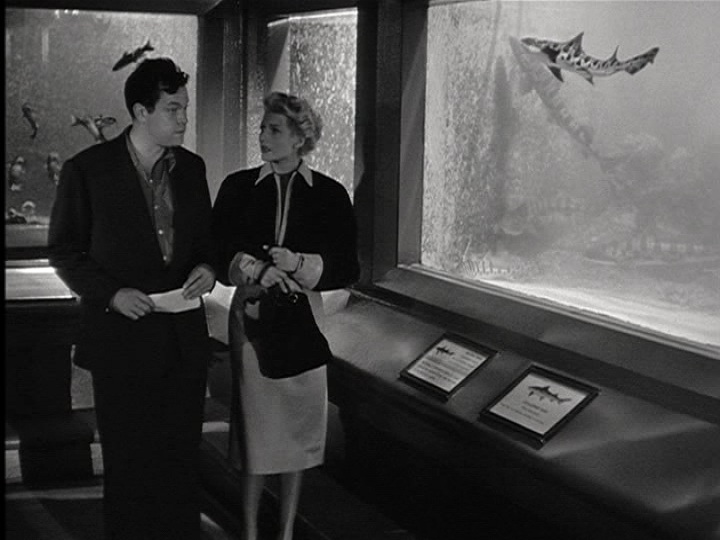
Story-wise, The Lady From Shanghai plays out like a typical noir page-turner. Each scene keeps revealing new and intricate turns. To describe its plot properly would take about the amount of time to watch the film itself. But say what you want about the story, the film's look is a marvel on to its own. As an example I will take a single-shot from one of my favourite scenes - besides the house of mirrors climax - in the aquarium. The complexity of the lighting is a feast for the eyes, and I still can't tell whether it's in a real aquarium with strange refraction tricks or if it's a processing-screen behind them. The fish are distractingly huge, like Werner Herzog would say, they seem to be a metaphor for something but I don't quite know what.

Here are some screen-shots from one of the final moments in the aquarium, all taken from a single shot of Orson and Rita walking past the camera.

The beginning of the scene. Rita's full figure as she is walking and her face is half-cast in shadow. Orson is about to walk into frame.

Now we have both Orson and Rita in frame, walking towards us. The camera is currently stationary. Notice the shades of their clothing. Rita's coat is a pure black over a lightly shaded dress, you can't see the shape of her arms or chest, but you see her hands coming out, clinging on to a black purse. Orson is in a totally dark suit(in some shots it's all pure black), with a slightly less darker shirt underneath, along with his black hair, he's just a walking shadow save for his face and hands. It is to due to his dark attire that we can keep an eye on the white piece of paper he is holding, as it plays an important role to the story (I won't go into it here, I recommend watching the film).

They walk closer, the light has shifted a little darker in this shot. In movement, the light is constantly shifting up and down due to the water bouncing light in all sorts of directions. This is why it was important to separate the extremes of dark and light, because all the medium greys in between were going to be constantly shifting.

They come closer into a medium shot. Here, the camera begins to slowly turn right, constantly keeping the two slightly left-of-centre.

Even closer, and as the camera turns Orson's head casts a shadow over Rita's face.

I particularly love this frame. As Rita's face is being eclipsed, her eyes still glow out of the darkness. Their silhouettes become extremely defined in front of the bright fish-tanks.

However, notice when they're in front of a pure-black column. Rita's face and hair has become much brighter, but her body has completely disappeared. Orson is now walking in front of the camera as we come to the apex of its turn.

Both characters have switched sides, however remain left-of-centre. Rita still has glowing eyes and now she has gained glowing teeth!

Orson is the first to completely turn his back on us. Rita's face is becoming much darker, however when she's in front of a black column her blonde hair is lit up.


The camera has stopped turning and it is now tracking behind Rita and Orson. Pay attention to Orson's signature cheek, and how the light shifts as he walks past a black column. Keep in mind, this is all in the same shot.

For a while the camera tracks both characters as they talk with their backs turned towards us. How often do you see that in movies? I'm not saying it doesn't happen, but if it does, then it's usually for a reason. In this shot, it's totally casual, and it helps that it's just two characters - a man and a woman - so we can distinguish the voices.

The shot ends with both characters turning in profile looking at each other and the camera has stopped moving. Both faces are engulfed in shadow, with a bit of light outlining them both to separate them from the dark-grey background.


It's after that final turn, Rita talks for a bit, then there is a cut. To me this is the greatest example of black & white cinema. In the old days there was a lot of cigarettes being smoked on the screen, to create a constant movement even when the characters are static. To me it seems cheap and easy to just have someone smoking, especially if it adds nothing to the character. That's why I liked Orson Welles' films as he would always be inventive with movement. So go watch The Lady From Shanghai and see how film is really made!

Feminism +Tim Burton's Alice In Wonderland

I've been reading some interesting stuff about feminism in cinema. It's a blatant fact that cinema is a male-dominated medium, and therefore we may not realize how conditioned we are to accepting masculine-driven stories (even by female directors eg Kathryn Bigelow). What we normally have is a story starting with a central character in the centre of a social disruption, then the central character must find a way to resolve the disruption through a linear process, step by step. The typical layout is a male hero versus a male villain, and the male hero has a male buddy and/or female lover who will die, or at least be in hopeless peril, by the hand of the male villain which justifies the hero conquering the villain via horrible death or humiliation.

What, then, is the femenine-driven story? I don't know if it's been clearly defined, but characteristics include an episodic narrative, emotionally based conflict and resolve, often (but not always) melodramatic. Opposed to the masculine identity of going out on epic adventures and quests, the feminine story is typically domestic, reflective and explores personal identity. A feminist often asks what is the role of a woman in the story? A mother? A wife? A daughter? A damsel/princess in distress? A whore? It is important to understand the location (place and time) of the female character, as different cultures/timeframes will have different, sometimes severe, social expectations for her.

This brings me to Tim Burton/Disney's recent version of Alice In Wonderland. Perhaps I looked at it in the wrong light in my harsh review a while back, perhaps I wasn't considering the feminist point of view. I have to ask, then, is this version of Alice In Wonderland a femenine story?

Of course it isn't!!

It's just the same as any masculine story only the genders have been reversed. In doing so they have turned Alice into a...


...a man!


Defined muscular exterior, phallus in hand...is this an appropriate role model for little girls? To become a man? Not that there's anything wrong with it, however I preferred the original book - episodic, emotional, reflective of personal identity - seems a more feminine type of story. Perhaps we're too conditioned, the female audience included.

There is more to explain but I want to leave that for whenever I may get around to making a video-review of this movie.

Voice-over narration in movies.

Observe the following chatlog:
[03:30] hobblin> ya idk blade runner just didnt deliver to me
[03:30] hobblin> maybe i had too high expectations
[03:30] hobblin> oh and dear god the voice overs by harrison ford
[03:30] hobblin> they were just awful
[03:30] hobblin> it was like B movie quality
[05:51] Archfriend> hobblin
[05:51] Archfriend> you watched the Theatrical cut?!?!!
[05:51] Archfriend> no wonder why you thought it sucked


This gets me thinking how there are some movies that get a "Director's Cut" and the first thing they do is eliminate the voice-over narration that featured prominently in the theatrical release. Bladerunner is an example, another I can think of is The Dark City. In both cases, the directors (Ridley Scott and Alex Proyas, respectively) decided the voice-over was disengaging for the audience. A deconstructionist like myself may lead to the conclusion that it was an executive decision, seeing as these were both big studio films. This is where we come to an audience-divide, where the executives are both right and wrong.

The main clash between the executives and the directors comes down to whether profit should get in the way of good film-making. An executive believes the largest portion of consumer-market are morons, it is these people who they are aiming to extract all the money from. So what satisfies the moron? How do we appeal to them?

What morons want, no, what they need is security. They need nurturing; everything must be spelled out clearly. Subtlety does not work, it has to be over-the-top for the moron to even register the moment. They have to have their hands held like little babies, then have a road-map spread out in front of them with a red mark circling the destination point and a dotted line indicating the journey. Then the journey must be safely completed in a three-act structure.

A (good) director, on the other hand, assumes the general audience is intelligent enough to know their algebra and they don't always need their variables to be constants. They can put the pieces together - and enjoy doing it! Perhaps the theory might be uncertainty generates excitement and excitement generates profit.

So who's right?

Just kidding, that was a trick question. Right and wrong doesn't even apply to this argument. Both types of movies have made lots of money and both types of movies have also flopped.

Bladerunner and The Dark City could both fall under the science-fiction-slash-noir category, however Bladerunner was more successful due to its grandiose visuals being so new at the time and The Dark City flopped due to its grandiose visuals not being such an appreciated spectacle as other films of its time plus the story failed to be engaging (most likely due to the voice-over giving away the big twist at the beginning of the film, effectively amputating its own legs it was to stand on).

Perhaps there are many films that could do with a make-over and dropping its voice-over all together. For example, I perceive How To Train Your Dragon would be ten times better without it. Another example is Kick-Ass.
((try to think of more examples later))


But when does voice-over actually enhance a story? I may be exploring the executive's nightmare-realm here, but I can think of two examples based on movies I've enjoyed:

ONE - THE UNRELIABLE NARRATOR
This is when the narrator can speak only from their own perspective and they may or may not be wrong. This unreliability becomes a type of brain-food for the audience as we now have to sift through the given information and sort out for ourselves what could be fact or fiction, and how it is necessary to understand the story.

TWO - SPEAKING IN PAST-TENSE
When a narrator is speaking from the future, most likely in a period piece, the film can give the sense of being very novel-like, whether being adapted from a novel or not. The enjoyment comes from the narrator revealing the story as it's happening, or perhaps sharing information that can not be shown. Sometimes the narrator might not be talking about the story at all, just rambling on some obscure philosophy about something.

It is also entirely possible to have a combination of the two, like in Michael Haneke's The White Ribbon.

To be honest, there should be more to this blog post, but this is as far as I got in my draft. I could be exploring and deconstructing some examples of good voice-over (and maybe some bad ones), but the effort to slug through all that is more than I could ever muster. I can not even bring myself to give empty promises on future blog posts about the subject. If the discussion should go any further, I suppose that can be done in the comments.